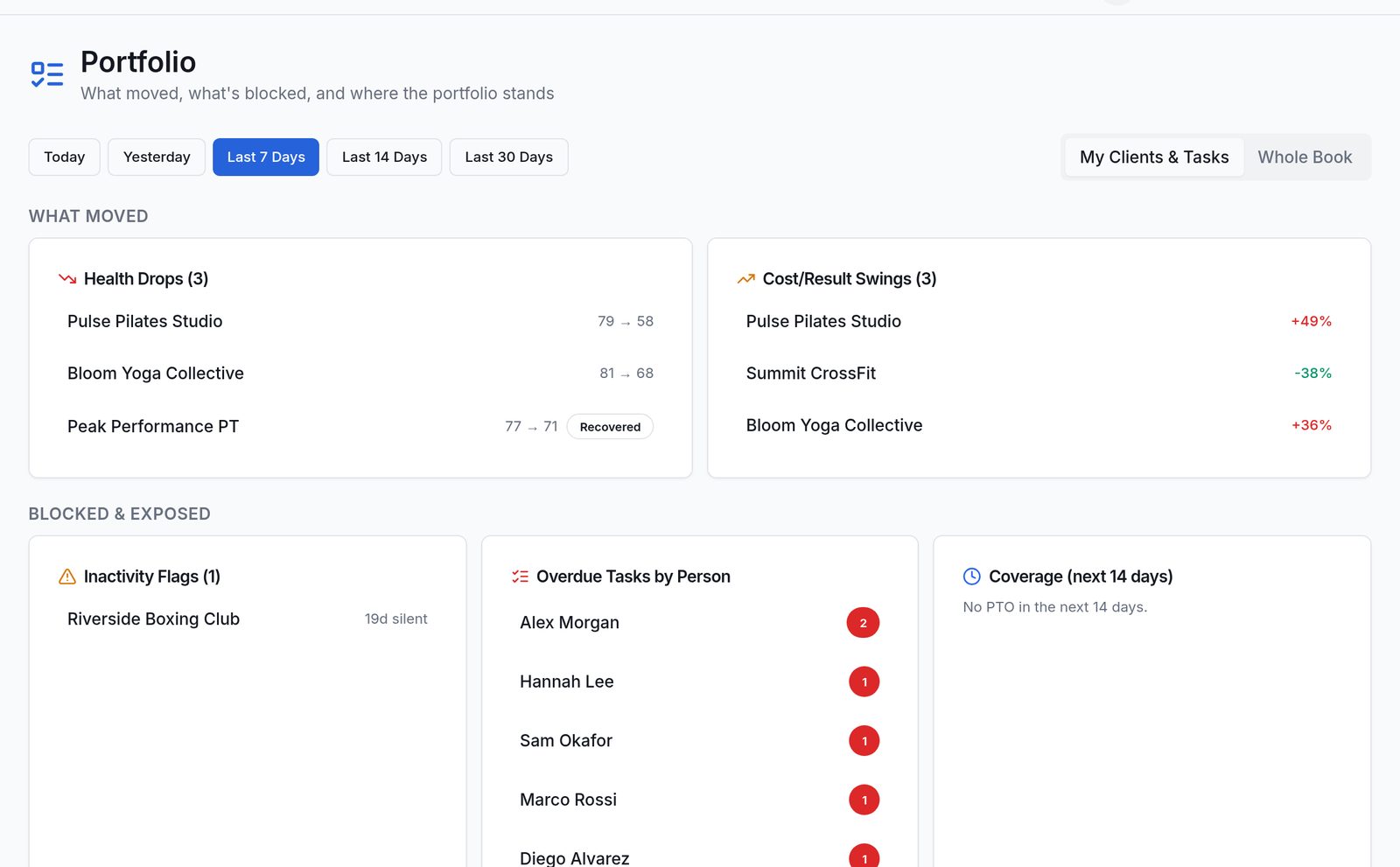
Every agency owner has said yes to a new client and then watched the team drown for the next two months. Deliverables slip, the best account manager starts looking tired, and an existing client quietly notices that response times got worse.
The problem is not saying yes. Growth is the point. The problem is saying yes without knowing how much room the team actually has.
Agency capacity planning sounds like something for 200-person firms with an operations department. It is not. For a team of 3 to 15 people, it takes one spreadsheet, a few weeks of honest time data and a 10-minute weekly check.
Step 1: Measure real hours per client, not guessed ones
Start with the question most agencies have never answered accurately: how many hours does an average client actually take each month?
Not the number in your pricing model. The real one, including the parts nobody budgets for:
- Campaign management and optimization
- Creative requests and revisions
- Reporting and the monthly call
- Prep before the call and follow-up after it
- Slack messages, quick questions and "can you just check" requests
- Fixing things that broke
The only way to get this number is time tracking by client for at least four weeks. People hate timesheets, so make it light: log in 30-minute blocks, tagged by client, at the end of each day.
When we did this in our own agency, the answer surprised us. We had priced paid media clients assuming around 8 hours a month. The real average was closer to 14, and almost all of the gap came from call prep, follow-ups and reporting. The campaign work itself was on budget. The admin around it was not.
We priced for about 8 hours. The highlighted admin is where the extra 6 came from.
Step 2: Work out real capacity per person
Next, figure out how many hours each person can actually give to client work in a week. It is less than you think.
Start with 40 hours and subtract:
- Internal meetings and admin: usually 5 to 8 hours
- Training, learning and tools: 2 to 3 hours
- Approved time off, prorated across the month
A realistic number for most agency staff is 28 to 32 client hours a week. Plan above 32 and you are planning for burnout.
Then set a target utilization. Aim for 80 to 85% of that capacity on client work. The remaining 15 to 20% is not waste. It absorbs the new client onboarding, the account that suddenly needs attention and the week someone gets sick.
Step 3: Calculate your headroom
Now the math is simple.
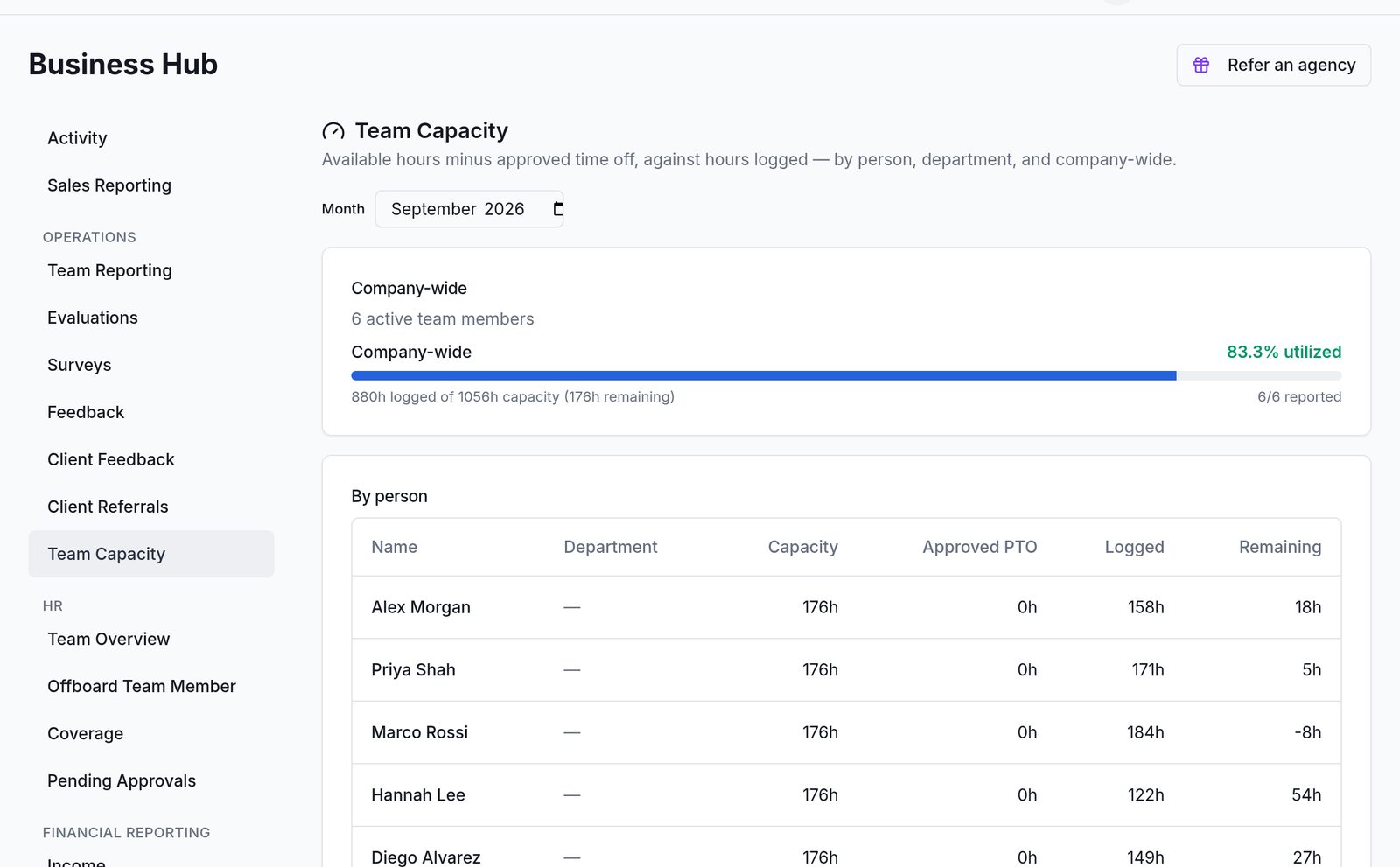
Team client capacity = sum of each person's weekly client hours, minus approved time off.
Current load = hours actually logged on client work last week (or the four-week average).
Headroom = capacity at your target utilization minus current load.
A worked example for a five-person team:
That headroom of 16 hours a week is roughly 64 hours a month.
If an average client takes 14 hours a month, this team can absorb four more clients before it is at target utilization. Five would push them over. And the first month of a new client usually takes one and a half to two times the normal hours because of onboarding, so the safe number right now is closer to three.
That is a completely different conversation from "I think we can handle it".
Step 4: Look at people, not just the total
Team-wide numbers hide the real risk. A team at 80% overall can still have one media buyer at 110% and an analyst at 55%.
Look at utilization per person every week:
- Above 100%: this person is working overtime or dropping things. Move work off them this week.
- 90 to 100%: fine for a sprint, not sustainable for a quarter.
- 70 to 90%: healthy.
- Below 60%: either they have room for new clients or they are not logging time. Find out which.
The person above 100% is usually your best one, because everyone routes work to the person who gets it done. That is exactly the person you cannot afford to burn out.
Step 5: Know your hiring trigger in advance
Capacity planning is most useful when it tells you when to hire before you need to. Decide your rule now, while you are calm:
When team utilization is above 85% for three weeks in a row, or the sales pipeline has enough likely deals to push it there, we open a role.
Hiring takes 4 to 8 weeks, and a new person takes another month to be fully productive. If you wait until the team is drowning, you will spend two months in the danger zone. Your clients will feel it.
Cut hours before you add people
Before hiring, look at where the hours per client go. In most paid media agencies, a big part of the gap between planned and real hours is recurring admin:
- Pulling numbers from ad platforms before each call
- Building the monthly report by hand
- Writing call notes, follow-up emails and tasks afterwards
In our own numbers, prep and follow-up around a single client call added up to about three hours. Moving that into one flow, with the briefing built from live campaign data and the notes, tasks and follow-up email drafted automatically (what the MNCL360 Call Assistant does), brought it to about 20 minutes. Across 50 clients that is well over 100 hours a month, the equivalent of most of a full-time hire.
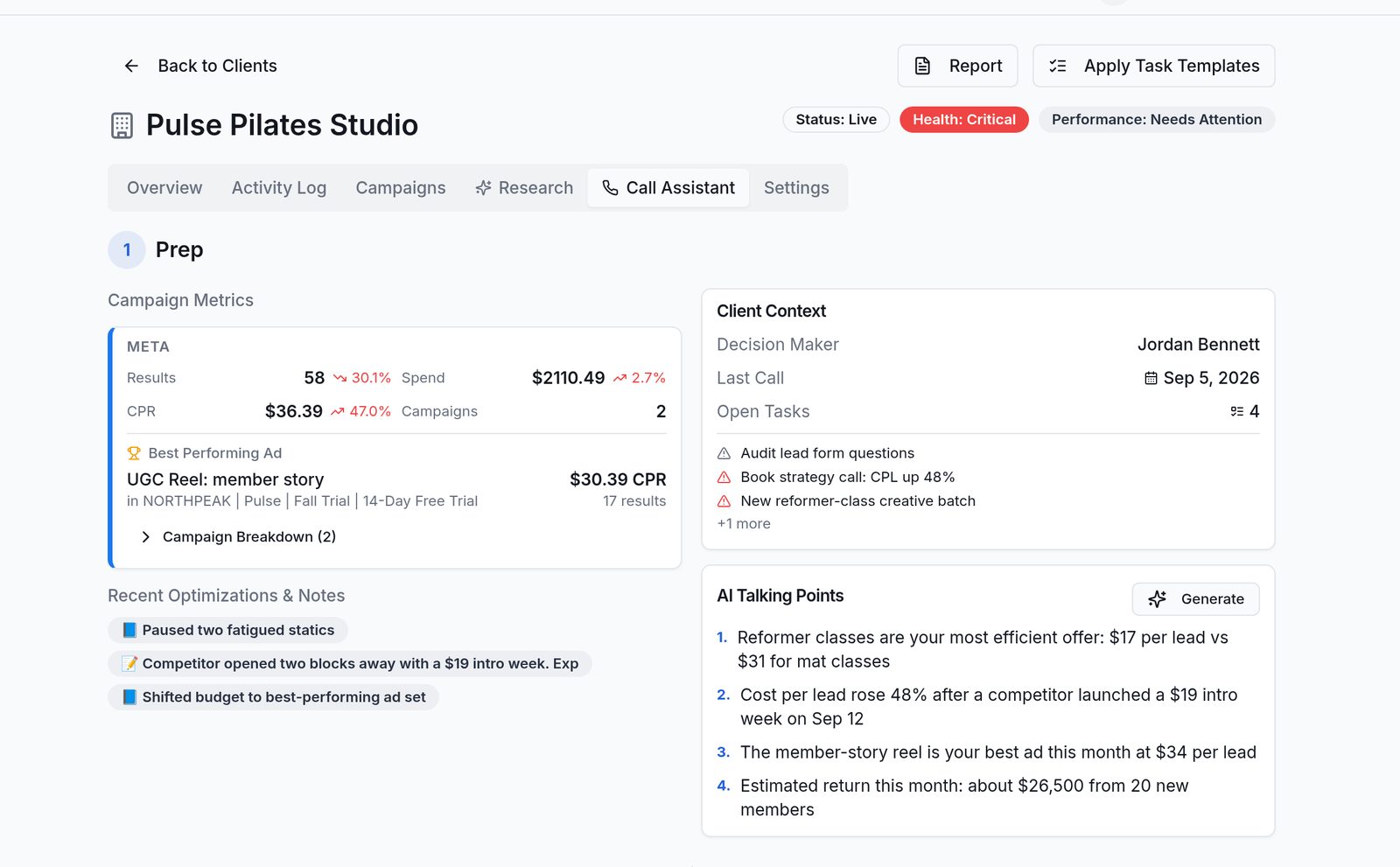
Whatever tools you use, audit these recurring tasks first. Hours you remove from every client, every month, compound faster than any hire.
The 10-minute weekly capacity check
Put this on the calendar for Monday morning:
- Check team utilization for last week against your 85% target.
- Scan per-person utilization. Rebalance anyone above 100%.
- Subtract upcoming approved time off from next week's capacity.
- Compare headroom with deals likely to close this month.
- If you hit your hiring trigger, start the role today.
The takeaway
You do not need a complicated system to plan capacity. You need three honest numbers: real hours per client, real client hours per person, and what the team logged last week. With those, "can we take on five more clients?" stops being a gut call and becomes a two-minute answer.
Say yes to growth. Just know what yes costs before you say it.
Run your agency from one place
Client health, automated reports, AI call prep, tasks and team capacity for performance marketing agencies. 30 days free, no credit card.
Start free trial