Most agency owners find out a client is leaving on the cancellation call. By then the decision was made weeks ago, usually after a string of small signals that nobody on the team connected.
When we ran 50 paid media clients, our churn almost never came from one terrible month. It came from accounts that drifted. The results were fine, the client was polite, and then one day the owner "wanted to try something different".
The good news: drift leaves a trail. If you know where to look, you can see most churn coming a month out, while there is still time to fix it.
Why agency clients really leave
Ask a departing client why they are leaving and you will hear "budget" or "we're taking it in house". Those are the polite answers. Underneath, it is almost always one of three things:
- They stopped believing the ads work. Not because the numbers are bad, but because nobody connected the numbers to money in their bank account.
- They stopped hearing from you. Calls slipped, reports went out without context, and silence started to feel like neglect.
- Something broke and they found it first. Ads stopped, a form broke, leads went missing for a week, and the client noticed before the agency did.
Each of these shows up in your data before it shows up in a cancellation email.
The warning signs, in order of how early they appear
1. Call cadence slips (earliest signal)
The first thing that goes is the rhythm. A monthly check-in becomes six weeks. The client reschedules twice. Your account manager "will catch up next week".
Rule of thumb: any client without a real conversation in 21 days is at risk, no matter how good the numbers look. Performance keeps a client happy for a while. The relationship keeps them for years.
2. The owner goes quiet
Watch who shows up. When the decision maker stops joining calls and sends a junior staff member instead, the account has been deprioritized in their head. The same goes for emails that used to get a reply in an hour and now take three days.
3. Cost per result creeps up without a story
A 30% jump in cost per lead is not a churn signal by itself. A 30% jump that nobody explained is. Clients forgive bad weeks. They do not forgive surprises.
If your cost per result is up more than 20% against the prior period and there is no note, no call and no plan attached to it, treat it as an open wound.
4. Open tasks pile up
Count the tasks you owe a client. When a client has four or more overdue items (a landing page tweak, a new creative batch, a tracking fix), they feel it even if they never mention it. Backlogs read as "they're too busy for us".
5. Delivery problems (the loudest signal)
Stopped ads, exhausted budgets, broken lead forms, leads not reaching the CRM. These are escalations. The client usually spots them within days, and every day they spot it before you do costs you trust you have to earn back.
6. Sentiment changes in call notes
Read your account manager's notes from the last two calls. Words like "frustrated", "asked about other options", "wants to see more leads" or "questioned the budget" are the client telling you, in advance, what the cancellation email will say.
Turn the signals into a health score
Signals are only useful if someone checks them. The simplest way to make that happen is to give every client a status that updates on its own and sort your client list worst first.
A practical scoring model has five states:
- Healthy: results on track, a call in the last 21 days, nothing overdue.
- Manageable issues: one soft signal, like a call slipping past 16 days or a small performance dip.
- Needs attention: two or more signals, or cost per result up 20% or more with no plan.
- Critical: no call in 30 days, or a sharp performance drop the client has noticed.
- Escalation: ads stopped, budget gone or leads not being delivered. Fix it today.
Add a sixth state, new relationship, for the first 60 days of a client. New clients behave differently, and you do not want onboarding noise triggering alarms.
The important part is that every status comes with a reason. "Needs attention" on its own is useless. "Needs attention: cost per result up 36%, no call in 18 days" tells the account manager exactly what to do next.
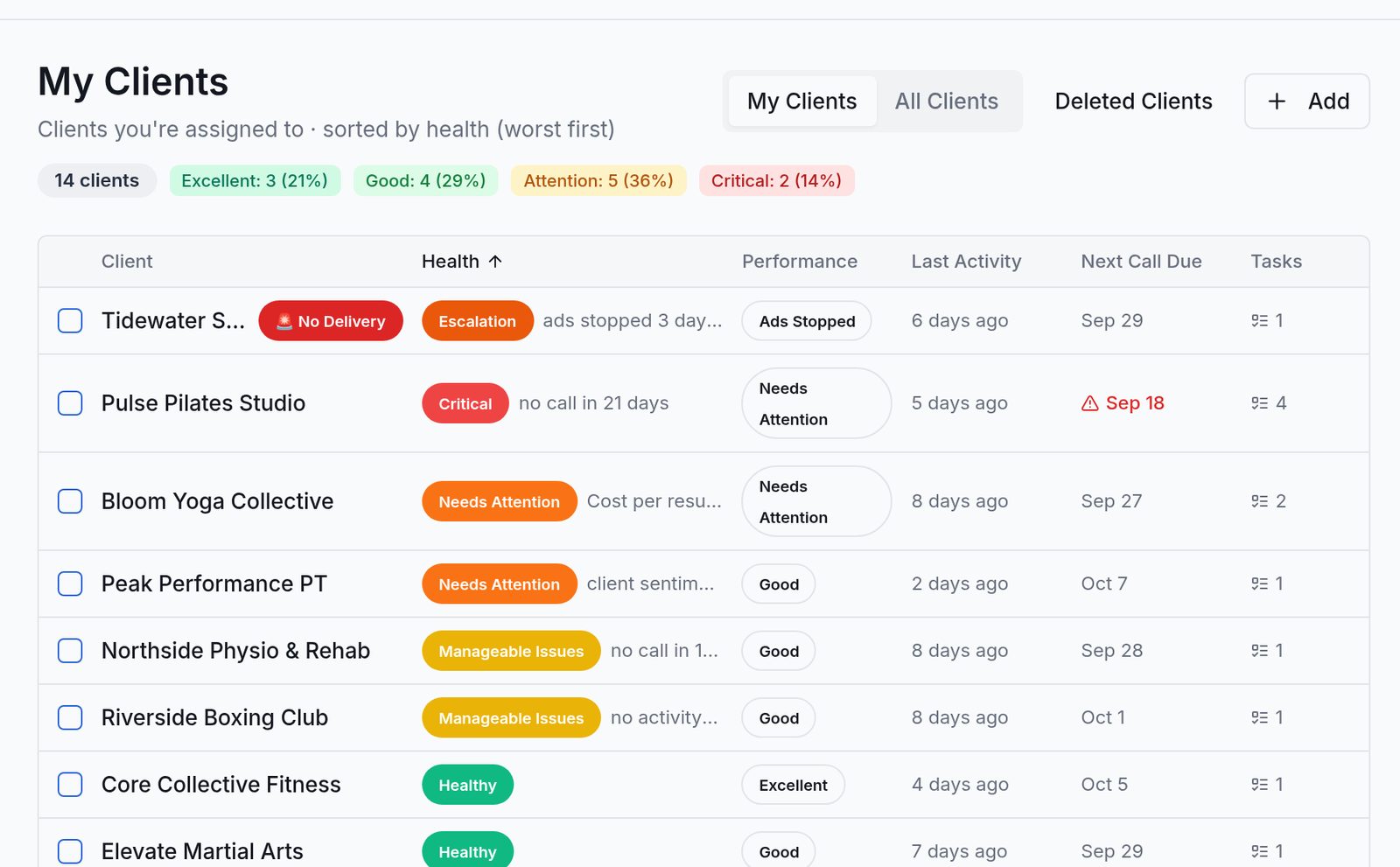
This is the logic behind client health scoring in MNCL360, which takes a snapshot of every client every morning. You can run the same model in a spreadsheet if you are disciplined about updating it.
The 15-minute weekly churn review
Once statuses exist, the process is short. Every Monday:
- Sort all clients worst first. Start at the top and stop when you reach healthy accounts.
- For every escalation, assign an owner and a deadline today. Not this week. Today.
- For critical and needs attention accounts, book a call. Send a booking link rather than asking "when works for you?". It removes one round of back and forth.
- Write the story before the call. What changed, why, and what you are doing about it. Clients forgive problems that come with a plan.
- Check last week's list. Did each at-risk account move up? If not, escalate to the owner of the agency.
That is it. Fifteen minutes a week replaces the quarterly "how are our clients doing?" meeting that never finds anything until it is too late.
What to say on a save call
When an account is at risk, the call is not a performance review. It is a reset. A simple structure:
- Open with the business, not the ads. "How has the last month been for bookings on your side?" You want to hear their version before you show yours.
- Name the problem before they do. "Cost per lead went up in September. Here is why, and here is what we already changed."
- Translate results into money. "You got 118 leads. At your close rate of 20% and an average sale of $1,800, that is about $42,000 in new revenue from $3,100 in spend." Owners stay for revenue, not for click-through rates.
- Agree on one visible next step with a date, and send it in writing within the hour.
If you only change one thing, change the follow-up. A recap email that lands while the call is still fresh in the client's mind does more for retention than any report.
A note on reporting
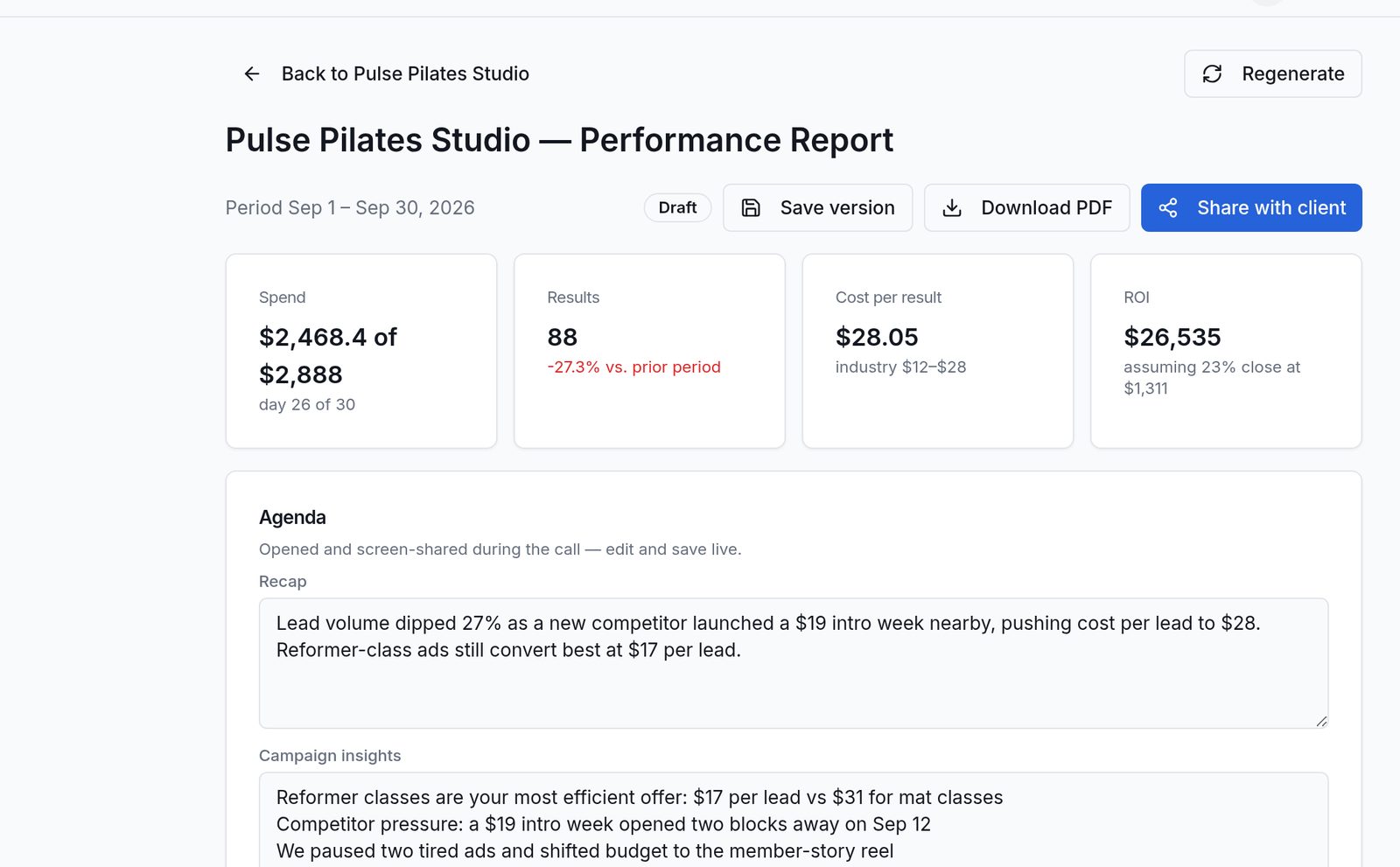
Many of the at-risk accounts we saw had perfectly good reports. The problem was that the report arrived as a PDF with no voice attached. Reports should answer three questions in plain language: what happened, why, and what we are doing next. If a report cannot be understood in two minutes by an owner reading it on a phone, it is not doing its job.
The takeaway
Churn is rarely sudden. It is a slow build of missed calls, unexplained numbers and small failures the client noticed first. Give every client a health status with a reason, review it every Monday, and act on the top of the list the same day.
Do that consistently and you will still lose clients. But you will lose the ones you chose to lose, not the ones you never saw coming.
Run your agency from one place
Client health, automated reports, AI call prep, tasks and team capacity for performance marketing agencies. 30 days free, no credit card.
Start free trial